
The Best Meeting Rooms Are the Ones People Do Not Have to Think About
 Holli
Holli
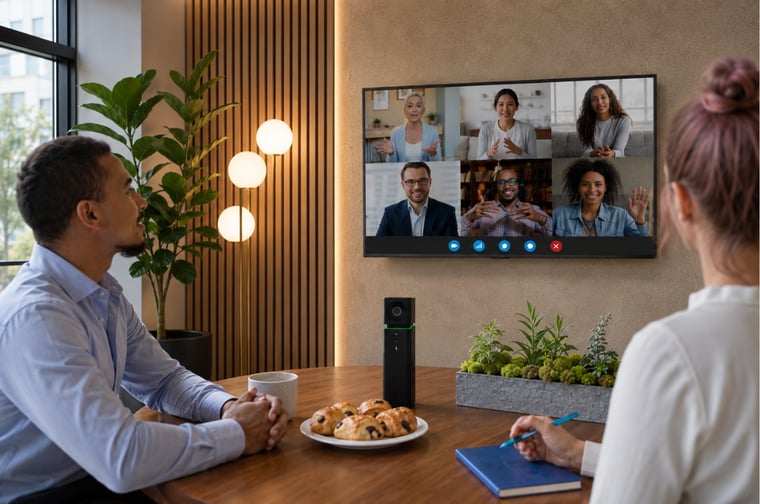
Every organization has experienced it: a meeting is scheduled, people join on time, and then the room gets in the way. The display will not connect. The camera is missing. Audio is not working. Five minutes disappear before the conversation even begins.
In a world where meetings happen constantly, those small moments of friction add up. Teams move between office spaces, home offices, customer sites, and shared workspaces. They switch between platforms, devices, and room types.
But for the people using the room, the expectation is still simple.
Walk in. Connect. Start the meeting.
That expectation sounds basic, but it is exactly where many meeting spaces still fall short.
A meeting room that requires special instructions, the right cable, a specific platform, a room account, an IT ticket, or a workaround is not really finished. It may be equipped. It may be expensive. It may have impressive features. But if people hesitate before using it, the room has already created friction.
The best meeting rooms are the ones people do not have to think about.
Simplicity is not the absence of technology
Simple does not mean basic. It does not mean underpowered. It does not mean cutting corners.
In meeting spaces, simplicity means the technology is doing its job quietly. The camera works. The audio works. The display works. The laptop connects. The room behaves the same way every time.
Users should not need to understand the system architecture. They should not need to know which device is controlling the room. They should not need to guess whether the meeting will work better on Teams, Zoom, Google Meet, Webex, or another platform.
They should be able to bring their meeting, connect to the room, and get on with the conversation.
That is the real value of a well-designed meeting space: it disappears into the workflow.
Complexity creates support demand
Every extra step in a room creates a support risk.
A room that requires training will eventually be used by someone who has not been trained. A room with multiple modes will eventually be left in the wrong one. A room built around a single platform will eventually host a meeting on another. A room that depends on a dedicated account, license, or configuration will eventually require maintenance.
For IT teams, this creates a familiar pattern. The room works well when everything is set up correctly, but support calls still happen because users do not experience the room as simple.
That is why support calls per room can be a better measure of success than the feature list.
If people can operate a room independently, it consumes less IT time. If every room follows the same standard, troubleshooting becomes faster. If the experience is consistent across locations, teams do not have to relearn the room every time they move.
The best meeting room standard is not just the one with the most features. It is the one people can actually use without help.
The room should match how people already work
Modern meetings are not confined to one platform or one device. A single organization may use Teams internally, Zoom with customers, Google Meet with partners, and browser-based tools for ad hoc collaboration.
That reality makes flexibility essential.
A Bring Your Own Meeting approach gives users control over the meeting experience they already know. Instead of forcing the room to own the meeting, the room supports the user’s device and platform of choice.
For many organizations, this is especially useful in smaller rooms, shared spaces, regional offices, and temporary environments where a dedicated room system may be more complexity than the space requires.
The room still needs high-quality video, clear audio, a reliable display connection, and a clean user experience. But it does not always need to become a platform-specific system with extra licensing, configuration, and support overhead.
Sometimes the simplest answer is also the most scalable: let users bring the meeting, and let the room make it better.
Small rooms are where simplicity matters most
Small meeting rooms are often the most widely used and least consistently equipped spaces in an organization.
They may be huddle rooms, private offices, shared team spaces, focus rooms, regional meeting areas, or quick-turn collaboration spaces. They are often used for short meetings, customer calls, internal check-ins, interviews, project updates, and hybrid conversations that happen with little notice.
These rooms need to be easy.
Nobody wants to book a small room for a 20-minute call and spend the first five minutes troubleshooting audio. Nobody wants to call IT because the display did not wake up or the camera did not appear. Nobody wants to explain to a customer that the room is almost working.
In these spaces, the room experience has to be obvious.
That means fewer decisions for the user, fewer moving parts for the installer, and fewer surprises for IT.
Standardization makes simplicity scalable
A single great meeting room is helpful. A repeatable room standard is powerful.
When an organization standardizes around a consistent meeting room kit, every location benefits from the same process. Quoting becomes faster. Installation becomes easier. Users know what to expect. IT teams know what to support. Partners can package and repeat the solution across rooms, sites, and customers.
Standardization also helps avoid the slow creep of room-by-room complexity. Without a standard, each space can become its own custom project. Different cameras, different audio devices, different cables, different control methods, different user instructions.
That may work for one room. It does not scale well across dozens, hundreds, or thousands of spaces.
A good standard answers the practical questions before they become support issues:
What does the user plug in?
What device controls the meeting?
How does the display connect?
How does audio work?
What happens if the user changes platform?
Can the same approach work in a boardroom, a huddle room, and a temporary project space?
The more consistent those answers are, the easier the room is to deploy and support.
Partners have an opportunity to simplify the conversation
For resellers, integrators, and channel partners, simplicity is not just a technical advantage. It is a sales advantage.
Customers are often not asking for more complexity. They are asking for fewer problems.
They want rooms that are easy to quote, easy to install, easy to explain, and easy for employees to use. They want fewer support calls. They want faster rollouts. They want confidence that the room will work when someone walks in with a laptop and a meeting to join.
That creates a strong opportunity for partners to package meeting rooms around outcomes instead of feature lists.
A simple room bundle can be easier for customers to understand and easier for partners to sell:
One room type.
One kit.
One display.
One cable experience.
One repeatable installation process.
That clarity can turn a single room opportunity into a broader standardization conversation.
Better meeting rooms feel invisible
The goal of meeting room technology is not to impress users with the system. It is to help them forget the system is there.
When a room is simple, people start the meeting faster. Remote participants hear and see the room clearly. IT receives fewer support calls. Partners can repeat the solution with confidence. Organizations can scale the experience across more spaces.
That is what better meeting room design should deliver.
Not more instructions.
Not more workarounds.
Not more complexity hidden behind the wall.
Just a room that works the way people expect it to work.
Better meetings begin when the technology stops getting in the way.

-2.png?width=450&height=250&name=Picture%20Blog%20%20(2)-2.png)